Friday, May 12, 2023

Green Comet Comet C/2022 E3 (ZTF) to be closest to Earth on 1 Feb. Here's how to watch it in India


A green comet named Comet C/2022 E3 (ZTF), which last passed by our planet about 50,000 years ago and is expected to be most visible to stargazers this week, is seen journeying tens of millions of miles (km) away from Earth in this telescope image. (via REUTERS)

Here's when, where and how you can see the Green Comet to witness a once-in-a-lifetime celestial happening


Get ready for a once-in-a-lifetime celestial display! On 1 February, Comet C/2022 E3 (ZTF) will be visible to the naked eye from Earth, providing an opportunity for astronomers and space enthusiasts to observe a unique event. The comet will be at its closest distance to Earth on this date, making it viewable in nearly every state in India and across the world.


This greenish-tinged comet has a nucleus surrounded by a tadpole-shaped tail that stretches for millions of kilometers. It recently completed its orbit around the Sun and is now on its way out to the outer reaches of the solar system.

On a cosmic scale, the comet will be only 42 million kilometres away from Earth's surface when it is closest. The comet's 50,000-year orbit around the Sun is what distinguishes it from other objects. The last time it passed this close to Earth, Neanderthals still roamed the planet and modern humans had not yet developed.

How to watch the Green Comet?

According to Shilpi Gupta, a Scientific Officer at the Birla Planetarium in Kolkata, the Comet C/2022 E3 (ZTF) will not be easily visible to the naked eye and will require a binocular and clear, dark skies for proper observation. Light pollution from cities can hinder viewing, so it's recommended to travel to a location with reduced light for the best experience. With these conditions, stargazers will be able to see the faint comet moving across the sky.

On Monday, it appeared between the Big Dipper and Polaris, the North Star. And on Wednesday, it was positioned to appear near the constellation Camelopardalis, bordered by Ursa Major, the Big Dipper and the Little Dipper.

When and where to watch the cComet C/2022 E3 (ZTF)?

The optimal time to observe the Comet C/2022 E3 (ZTF) will be after 9:30 PM, provided that the skies are clear and dark. To spot the greenish-tinged comet in the skies above India, look towards the south of the Pole Star. The comet will be moving in a southerly direction and will eventually reach the head of the Orion constellation.

Gravitational forces from within the solar system can dislodge comets from the Oort cloud, causing them to move towards the inner solar system where they become more visible as they get closer to the heat from the Sun. On average, fewer than a dozen comets are discovered each year by observatories around the world.


Solar Storm Caused By Huge Coronal Hole 20-30 Times Earth's Size Could Hit The Planet On Friday


The coronal hole is now facing our planet. When the solar storm arrives at Earth, it is likely to result in Arctic auroras, which are a beautiful spectacle.


What is a coronal hole?

A coronal hole is a dark area in the solar corona that can be observed in extreme ultraviolet and soft X-ray solar images, and appears dark because it is a cooler, less dense region compared to the surrounding plasma. A coronal hole is a region of open, unipolar (having a single pole) magnetic field, which allows the solar wind to escape more readily into space, resulting in streams of relatively fast solar wind, according to the National Oceanic and Atmospheric Administration (https://astronomy.sfconferences.com).

What is a co-rotating region on the Sun?

A co-rotating interaction region (CIR), or a compression region ahead of a coronal hole high-speed stream, is expected to enhance the solar wind field. The interaction of slower, ambient solar winds ahead of the high-speed stream results in the formation of a CIR. 

Due to the coronal hole high-speed stream influences, there will be an increase in the solar wind speed, according to the https://astronomy.sfconferences.com Influences from the periphery of the March 20 Coronal Mass Ejection (CME) is likely to result in additional minor enhancements in solar wind speed. 

What is a coronal mass ejection?

A coronal mass ejection is a large expulsion of plasma and magnetic field from the Sun's corona, and can travel at speeds ranging from slower than 250 kilometres per second, to as fast as 3,000 kilometres per second. 

The formation of the CIR, the onset of the coronal hole high-speed stream influences, and other coronal mass ejection influences began by late March 23. 

Coronal hole that could result in solar storm on Friday is the size of 20-30 Earths

The coronal hole which is likely to result in a solar storm that could hit Earth on Friday is about 300,000 to 400,000 kilometres across, a Business Insider report said, quoting Alex Young from NASA's Goddard Space Flight Center. Young said that the size of the coronal hole is equivalent to about 20 to 30 Earths lined up back-to-back. 

However, since a minor stream of solar wind is heading for Earth, the storm is likely to be less severe. 

An X1.2 flare occurred from a region on the Sun on March 29, peaking at 8:03 am IST. An X1.2 solar flare is a powerful solar flare, and belongs to the X-class, which denotes the most intense flares. This resulted in an R3 HF (High Frequency) radio blackout event. An R3 event is a strong radio blackout event in which there is a wide-area blackout of high-frequency radio communication, and loss of radio contact for about an hour on the sunlight side of the Earth. 

On March 24, Earth was hit by the most powerful solar storm in nearly six years. It was a severe G4 geomagnetic storm. This is a geomagnetic storm which can disrupt power systems and spacecraft operations. A major disturbance of Earth's magnetosphere that occurs when there is a very efficient energy exchange from the solar wind to the space environment surrounding Earth is called a geomagnetic storm.


Thursday, May 11, 2023

Caught in the Act: Astronomers Detect a Star Devouring a Planet


A new study published online Wednesday, May 3, in the journal Nature documents the first observation of an aging star swallowing a planet. After running out of fuel in its core, the star began to grow in size, shrinking the gap with its neighboring planet, eventually consuming it entirely. In about 5 billion years, our Sun will go through a similar aging process, possibly reaching 100 times its current diameter and becoming what’s known as a red giant. During that growth spurt, it will absorb Mercury, Venus, and possibly Earth.

Astronomers have identified many red giant stars and suspected that in some cases they consume nearby planets, but the phenomenon had never been directly observed before. “This type of event has been predicted for decades, but until now we have never actually observed how this process plays out,” said Kishalay De, an astronomer at the Massachusetts Institute of Technology in Cambridge and the study’s lead author.


Researchers discovered the event – formally called ZTF SLRN-2020 – using multiple ground-based observatories and NASA’s NEOWISE (Near-Earth Object Wide Field Infrared Survey Explorer) spacecraft, which is managed by the agency’s Jet Propulsion Laboratory. The planet was likely about the size of Jupiter, with an orbit even closer to its star than Mercury’s is to our Sun. The star is at the beginning of the final phase of its life – its red giant phase, which can last more than 100,000 years.

As the star expanded, its outer atmosphere eventually surrounded the planet. Drag from the atmosphere slowed the planet down, shrinking its orbit and eventually sending it below the star’s visible surface, like a meteor burning up in Earth’s atmosphere. The transfer of energy caused the star to temporarily increase in size and become a few hundred times brighter. Recent observations show the star has returned to the size and brightness it was before merging with the planet.

So he turned to the NEOWISE observatory, which scans the entire sky in infrared light (a range of wavelengths longer than visible light) every six months. Launched in 2009 and originally called WISE, the observatory produces all-sky maps that enable astronomers to see how objects change over time.

Looking at the NEOWISE data, De saw that the star brightened almost a year before ZTF spotted the flash. That brightening was evidence of dust (which emits infrared light) forming around the star. De and his colleagues think the dust indicates that the planet didn’t go down without a fight and that it pulled hot gas away from the puffy star’s surface as it spiraled toward its doom. As the gas drifted out into space, it would have cooled and become dust – like water vapor becoming snow. Even more gas was then flung into space during the collision of the star and the planet, producing more dust visible to both the ground-based infrared observatories and NEOWISE.

“Very few things in the universe brighten in infrared light and then brighten in optical light at different times,” said De. “So the fact that NEOWISE saw the star brighten a year before the optical eruption was critical to figuring out what this event was.”

Five billion years from now, when our Sun is expected to become a red giant, swallowing up Mercury, Venus, and possibly Earth, the light show should be much more subdued, according to De, since those planets are many times smaller than the Jupiter-size planet in the ZTF-captured event.

“If I were an observer looking at the solar system 5 billion years from now, I might see the Sun brighten a little, but nothing as dramatic as this, even though it will be the exact same physics at work,” he said.

Most mid-size stars will eventually become red giants, and theorists think that a handful of them consume nearby planets each year in our galaxy. The new observations provide astronomers with a template for what those events should look like, opening up the possibility of finding more.

“This discovery shows that it’s worthwhile to take observations of the entire sky and archive them, because we don’t yet know all of the interesting events we might be capturing,” said Joe Masiero, deputy principal investigator for NEOWISE at IPAC at Caltech. “With the NEOWISE archive, we can look back in time. We can find hidden treasures or learn something about an object that no other observatory can tell us.”

More About the Mission

Launched in 2009, the WISE mission scanned the entire sky twice in infrared light, snapping pictures of three-quarters of a billion objects, including remote galaxies, stars, and asteroids. The WISE mission concluded in 2011, but two years later NASA repurposed the spacecraft to track asteroids and other near-Earth objects, or NEOs. Both the mission and the spacecraft were renamed NEOWISE.

JPL managed and operated WISE for NASA’s Astrophysics Division within the Science Mission Directorate. Edward Wright at UCLA was the principal investigator. The mission was selected competitively under NASA’s Explorers Program managed by the agency’s Goddard Space Flight Center in Greenbelt, Maryland.

JPL manages and operates the NEOWISE mission for NASA’s Planetary Defense Coordination Office within the Science Mission Directorate in Washington. The principal investigator, Amy Mainzer, is at the University of Arizona. The Space Dynamics Laboratory in Logan, Utah, built the science instrument. Ball Aerospace & Technologies Corp. of Boulder, Colorado, built the spacecraft. Science data processing takes place at IPAC at Caltech in Pasadena. Caltech manages JPL for NASA.


Visit Our Website: https://astronomy.sfconferences.com/ Our Conference Nomination:https://x-i.me/astrocon Visit Our Award Nomination: https://x-i.me/astronom Contact us :htt/astronomy.sfconferences.com/ Get connect==============

Face Book:https://www.facebook.com/profile.php?id=100090440442457 twitter: https://twitter.com/astronomyconfer instagram: https://www.instagram.com/isabella_aria21/ blogger:https://astrophysics23.blogspot.com/ Linkedin:https://www.linkedin.com/in/isabella-aria-5a4339267/ printerest:https://in.pinterest.com/astronomyc/


Wednesday, April 26, 2023

Home/News/Hubble spots runaway black hole leaving behind a trail of new stars Hubble spots runaway black hole leaving behind a trail of new stars

 If confirmed, the first-of-its-kind find would serve as convincing observational evidence that supermassive black holes can indeed be ejected from their parent galaxies.


This illustration shows the suspected runaway black hole and the thin trial of new stars linking it back to the parent galaxy it was apparently tossed out of.
NASA, ESA, Leah Hustak (STScI)

Astronomers think they’ve discovered a black hole some 20 million times the mass of the Sun speeding away from the core of a distant galaxy. And as the supermassive black hole barrels through intergalactic space, it’s compressing the scant gas and dust available out there, leaving behind a thin line of newly formed stars that's some 200,000 light-years long.

"We think we're seeing a wake behind the black hole where the gas cools and is able to form stars," said Pieter van Dokkum of Yale University, who first identified the star trail, in a NASA release. "What we're seeing is the aftermath. Like the wake behind a ship, we're seeing the wake behind the black hole."

Despite being relatively thin, the black hole’s stellar wake is packed with plenty of hot blue stars, making it nearly half as bright as the parent galaxy it traces back to. Based on the available evidence, the researchers think this black hole was likely ejected during a complex dance between three supermassive black holes that were involved in a pair of galaxy mergers. If confirmed, this would be the first observational evidence showing that supermassive black holes can be ejected from their parent galaxies.

A paper detailing the candidate runaway black hole and its stellar wake was published April 6 in The Astrophysical Journal Letters.

But it wasn’t an accretion disk that gave away this black hole. It was the unusual linear streak seemingly linking it to a nearby galaxy, which van Dokkum first noticed in an image captured by the Hubble Space Telescope. He and his team later confirmed the streak is indeed linked to the galaxy with follow-up observations taken with the Keck Observatory in Hawaii. 

"This is pure serendipity that we stumbled across it," said van Dokkum, who was initially looking at the Hubble image to investigate an unrelated dwarf galaxy. "I was just scanning through the Hubble image and then I noticed that we have a little streak.” He says he initially almost dismissed it as an imaging artifact, but “[w]hen we eliminated cosmic rays we realized it was still there. It didn't look like anything we've seen before."

The researchers also investigated the possibility that the streak was an astrophysical jet shooting from the black hole core of the nearby galaxy — which is not an uncommon sight. But the streak gets stronger farther from the core of the galaxy, and it doesn’t fan out at the end, leading the researchers to conclude the streak is instead a trail of new stars.

At the outer tip of the streak, where the suspected black hole is thought to be, the researchers also see evidence of a shock wave in front of the black hole. "Gas in front of it gets shocked because of this supersonic, very high-velocity impact of the black hole moving through the gas," said van Dokkum. "How it works exactly is not really known."

Visit Our Website: https://astronomy.sfconferences.com/ Our Conference Nomination:https://x-i.me/astrocon Visit Our Award Nomination: https://x-i.me/astronom Contact us :htt/astronomy.sfconferences.com/ Get connect============== Face Book:https://www.facebook.com/profile.php?id=100090440442457 twitter: https://twitter.com/astronomyconfer instagram: https://www.instagram.com/isabella_aria21/ blogger:https://astrophysics23.blogspot.com/ pinterest: https://in.pinterest.com/astronomyc/

Friday, April 21, 2023

Chandra X-ray Observatory identifies new stellar danger to planets


Chandra X-ray Observatory identifies new stellar danger to planets


Astronomers using data from NASA's Chandra X-ray Observatory and other telescopes have identified a new threat to life on planets like Earth: a phase during which intense X-rays from exploded stars can affect planets over 100 light-years away. This result, as outlined in our latest press release, has implication for the study of exoplanets and their habitability.

This newly found threat comes from a supernova's blast wave striking dense gas surrounding the exploded star, as depicted in the upper right of our artist's impression. When this impact occurs it can produce a large dose of X-rays that reaches an Earth-like planet (shown in the lower left, illuminated by its host star out of view to the right) months to years after the explosion and may last for decades. Such intense exposure may trigger an extinction event on the planet.

A new study reporting this threat is based on X-ray observations of 31  and their aftermath—mostly from NASA's Chandra X-ray Observatory, Swift and NuSTAR missions, and ESA's XMM-Newton—show that planets can be subjected to lethal doses of  located as much as about 160 light-years away. Four of the supernovae in the study (SN 1979C, SN 1987A, SN 2010jl, and SN 1994I) are shown in composite images containing Chandra data in the supplemental image.

The paper describing this result appears in the April 20, 2023 issue of The Astrophysical Journal.Prior to this, most research on the effects of supernova explosions had focused on the danger from two periods: the intense radiation produced by a supernova in the days and months after the explosion, and the energetic particles that arrive hundreds to thousands of years afterward.

If a torrent of X-rays sweeps over a nearby planet, the radiation could severely alter the planet's atmospheric chemistry. For an Earth-like planet, this process could wipe out a significant portion of ozone, which ultimately protects life from the dangerous ultraviolet radiation of its host star. It could also lead to the demise of a wide range of organisms, especially marine ones at the foundation of the food chain, leading to an extinction event.

After years of lethal X-ray exposure from the supernova's interaction, and the impact of ultraviolet radiation from an Earth-like planet's host star, a large amount of nitrogen dioxide may be produced, causing a brown haze in the atmosphere, as shown in the illustration. A "de-greening" of land masses could also occur because of damage to plants.

A separate artist's impression (panel #1) depicts the same Earth-like planet as having been abundant with life at the time of the nearby supernova, years before most of the X-ray's impacts are felt (panel #2).Among the four supernovae in the set of images, SN 2010jl has produced the most X-rays. The authors estimate it to have delivered a lethal dose of X-rays for Earth-like planets less than about 100 light-years away.

There is strong evidence—including the detection in different locations around the globe of a radioactive type of iron—that supernovae occurred close to Earth between about 2 million and 8 million years ago. Researchers estimate these supernovae were between about 65 and 500 light-years away from Earth.

Although the Earth and the solar system are currently in a safe space in terms of potential supernova explosions, many other planets in the Milky Way are not. These high-energy events would effectively shrink the areas within the Milky Way galaxy, known as the Galactic Habitable Zone, where conditions would be conducive for life as we know it.

Because the X-ray observations of supernovae are sparse, particularly of the variety that strongly interact with their surroundings, the authors urge follow-up observations of interacting supernovae for months and years after the explosion.

International Research Awards on Astrophysics and Astronomy #astrophysics #astronomy #science #nasa #space #physics #universe #cosmos #spacex #cosmology #quantumphysics #galaxy #astrophotography #blackhole #moon #stars #earth #solarsystem #quantummechanics #astronaut #elonmusk #spacefacts #scientist #hubble #einstein #physicsmemes #physicist #milkyway #theoreticalphysics #mars International Conference on Astrophysics and Astronomy Visit Our Website: https://astronomy.sfconferences.com/ Our Conference Nomination:https://x-i.me/astrocon Visit Our Award Nomination: https://x-i.me/astronom Contact us :htt/astronomy.sfconferences.com/ Get connect============== Face Bokk: https://x-i.me/astronom twitter: https://twitter.com/astronomyconfer instagram: https://www.instagram.com/astronomyconference8/ blogger:https://astrophysics23.blogspot.com/ Linkedin:https://www.linkedin.com/in/isabella-aria-5a4339267/ printerest:https://in.pinterest.com/astronomyc/


Tuesday, April 18, 2023


Arizona astronomers race to make sense of brightest gamma ray burst ever seen

Arizona astronomers race to make sense of brightest gamma ray burst ever seen
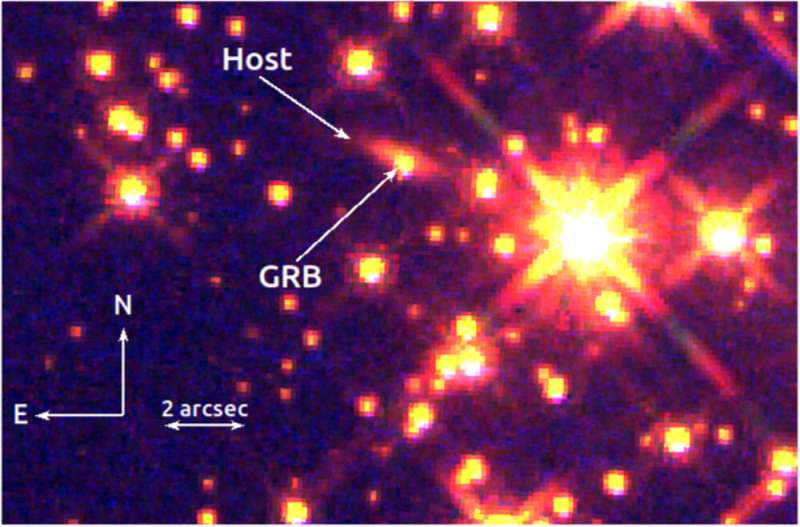
Combined HST images WFC3/UVIS and WFC3/IR (F625W, F125W, F160W) of the GRB 221009A field, observed on 2022 December 4. Note the clear appearance of an underlying host galaxy, with a disklike morphology. GRB 221009A is slightly offset from the center of the apparent host, off the disk plane. Credit: The Astrophysical Journal Letters (2023). DOI: 10.3847/2041-8213/acbd50

University of Arizona astronomers have joined an international effort to study the aftermath of the brightest flash of gamma rays ever observed. Observations involving various UArizona telescopes and instruments provide astronomers with a "cosmic lab" to study how massive stars die.

On Oct. 9, a pulse of intense radiation swept through the solar system, so exceptional that astronomers quickly dubbed it the BOAT—the brightest of all time. The source was a , or GRB—the most powerful class of explosions in the universe.

The burst triggered detectors on numerous spacecraft, and observatories around the globe followed up. After combing through all of the data, astronomers can now characterize just how bright it was and better understand its scientific impact. Two research teams at the University of Arizona joined the  to obtain and analyze the data to better understand what causes these outbursts of cosmic proportions. Papers describing the results will appear in a focus issue of The Astrophysical Journal Letters.

"This flash of gamma rays was the brightest burst ever recorded," said Kate Alexander, an assistant professor in the UArizona Department of Astronomy and Steward Observatory, who co-authored one of the papers. "You would expect one of this magnitude about once in 10,000 years."

Observations of the burst span the electromagnetic spectrum, from  to gamma rays, and include data from many NASA and partner missions, including the National Science Foundation's Karl G. Jansky Very Large Array radio telescope in New Mexico, NASA's NuSTAR observatory and even Voyager 1 in interstellar space. Alexander and other scientists presented new findings about the BOAT at the High Energy Astrophysics Division meeting of the American Astronomical Society in Waikoloa, Hawaii, on Tuesday.

The signal from the gamma ray burst, dubbed GRB 221009A, had been traveling for about 1.9 billion years before it reached Earth, making it among the closest known "long" GRBs, whose initial, or prompt, emission lasts more than two seconds. Astronomers think these bursts represent the birth cry of a black hole that formed when the core of a massive star collapsed under its own weight. As it quickly ingests the surrounding matter, the black hole blasts out jets in opposite directions containing particles accelerated to near the speed of light. These jets pierce through the star, emitting X-rays and  as they stream into space. As these streams of matter expand out into space, they crash into gas and dust around the star, producing long-lasting "afterglow" light that telescopes can detect across the entire electromagnetic spectrum.


A solar eclipse occurs when the Moon passes between Earth and the Sun

  A   solar eclipse   occurs when the   Moon   passes between   Earth   and the   Sun , thereby obscuring the view of the Sun from a small p...